
What uncertainty resilience can teach us about empathy in a polarized world.
A few years ago, a question began following me around. Why do some people become more compassionate during periods of uncertainty, while others become more rigid?
The question emerged during the pandemic, but it didn’t stay there.
I saw it in political conversations. In spiritual communities. In families. In friendships. Even within myself. Especially during moments when life felt uncertain, and the stakes felt personal.
The more I studied the psychology of belief, conspiracy thinking, trauma, identity, and emotional regulation, the more I began to wonder whether empathy and uncertainty tolerance might be more connected than we realize.
Because empathy requires something that certainty often does not.
Space.
To truly understand another human being, we must momentarily loosen our grip on our own perspective. To tolerate the possibility that our understanding is incomplete. It requires us to consider that another person’s experiences, fears, values, and conclusions may make sense from where they stand—even if we ultimately disagree.
That is not always easy.
In fact, neuroscience suggests that uncertainty itself can feel threatening to the brain. Researchers have found that uncertainty activates many of the same neural systems involved in processing potential threats. We are wired to seek patterns, predict outcomes, and reduce ambiguity. When those capacities are strained, stress rises.
This makes sense from an evolutionary perspective. A rustle in the bushes might be the wind. Or it might be a predator. For our ancestors, uncertainty could be costly.
Today, however, the threats are often psychological rather than physical. A changing world. Conflicting information. Political instability. Economic uncertainty. Shifting identities. Cultural transformation.
The nervous system still wants answers. And certainty can feel like safety. The challenge is that feeling safe and being accurate are not always the same thing.
Psychologists have long observed that when uncertainty increases, people often become more attached to groups, ideologies, identities, and belief systems that provide a sense of order. Social psychologist Michael Hogg's Uncertainty-Identity Theory suggests that people often turn toward strongly identified groups during periods of uncertainty because those groups provide clear answers about who they are, how they should behave, and how the world works.1
Again, this is not inherently problematic. After all, we all need to belong. The problem emerges when certainty becomes more important than reality. Or when belonging becomes dependent upon agreement. At that point, empathy often begins to erode.
We stop asking, What happened to lead you to that conclusion?
And start asking, How could anyone possibly believe that?
We stop seeing human beings. We start seeing categories.
Psychologists call this outgroup homogeneity bias. We perceive members of our own group as nuanced and diverse while viewing people outside our group as largely the same.
In everyday language, it looks something like this:
My side is complicated. Your side is crazy.
Once that shift occurs, curiosity becomes difficult, and empathy becomes expensive. Dialogue becomes nearly impossible.
The irony is that empathy itself may require a certain amount of uncertainty.
Not uncertainty about our values.
Not uncertainty about every fact.
But uncertainty about our own completeness. The willingness to acknowledge that there may be something we do not yet understand. That another person’s story contains information we do not possess. That our perspective, while valid, is never the whole picture.
Researchers studying intellectual humility have found that people who recognize the limits of their own knowledge tend to be more open to new information, less polarized, and more capable of productive conversations across disagreement.
In other words, humility creates room for empathy. And humility begins with a willingness to tolerate what certainty resists: the reality of uncertainty.
This may be one reason emotional regulation matters so much. When we are overwhelmed, threatened, or dysregulated, our capacity for perspective-taking declines. We become more reactive. More defensive. More certain.
When we are grounded, however, something else becomes possible. We can remain connected to our own truth while staying curious about someone else’s. We can disagree without dehumanizing. We can hold convictions without turning them into weapons.
Perhaps uncertainty resilience is not simply about tolerating ambiguity. Perhaps it is about preserving our humanity when ambiguity inevitably arrives.
Because uncertainty is not going away. The world will continue to change. Information will continue to conflict. Beliefs will continue to evolve. New questions will emerge. Old certainties will be challenged. We will not always know what comes next.
Maybe uncertainty resilience was never simply about our ability to tolerate the unknown. Perhaps it is also about our ability to remain compassionate within it.
Because the deeper challenge may not be determining who is right. It may be learning how to remain human when we are unsure.
How to stay curious when certainty would feel easier.
How to stay connected when division offers the illusion of safety.
How to remain open to complexity when simple answers promise relief.
If this is true, then cultivating empathy may require more than learning to listen better or communicate more skillfully. It may also require examining our relationship with uncertainty itself.
Because the more comfortable we become with not knowing, the less likely we are to demand certainty from ourselves or others.
And perhaps the real question is not what we believe when the ground begins to shift.
But who we become.
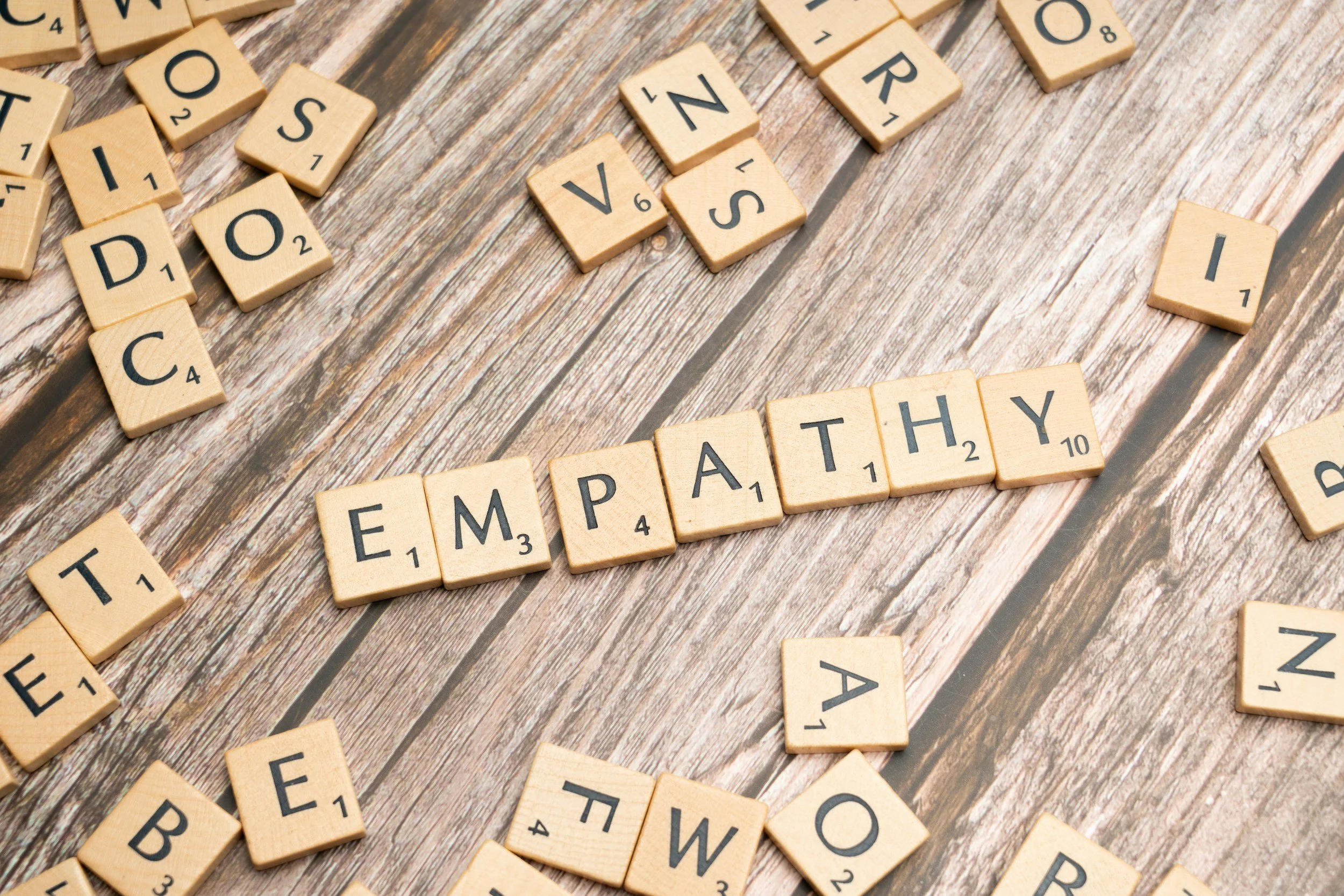
Photo credit: Markus Winkler on Upsplash
Thanks for reading The REAL™ | GritandGrace! This post is public so feel free to share it.
We love to hear from you! Feel free to leave a comment.
1 Hogg, M. A. (2007). Uncertainty-Identity Theory. Advances in Experimental Social Psychology, 39, 69–126.